Begin with a rule anyone can repeat
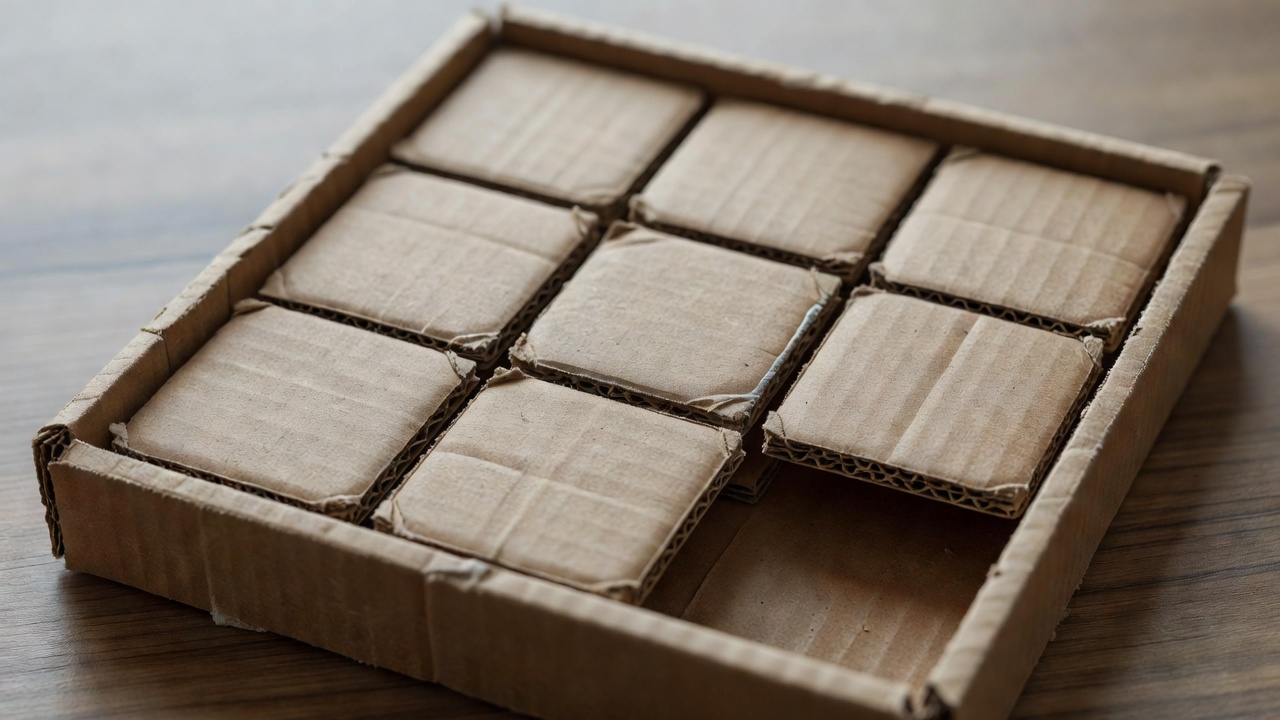
Draw a three-by-three grid and make eight numbered tiles. Put numbers 1, 2 and 3 across the top row, 4, 5 and 6 across the middle, then 7 and 8 at the bottom left and centre. Leave the bottom-right space empty. This is the goal arrangement. A legal move slides one tile horizontally or vertically into the neighbouring empty space. No diagonals, lifting, swapping or stacking are allowed.
The loose paper version depends on the player respecting that rule. That is useful: you can test whether the challenge is understandable before constructing walls or retaining features. Write the rule beside the grid. If a new player immediately asks whether a whole row may move, clarify that you count each single-tile slide as one move.
Use everyday material deliberately
A cereal box, ruler, pencil and scissors are enough for the first version. Choose card that lies flat and cut pieces of consistent size. Adult supervision is needed where appropriate; use a cutting mat and keep hands outside any blade path. Avoid tiny tokens if younger children may be nearby. The prototype should be easy to handle without requiring a fingernail under an edge.
For a practical starting scale, draw nine cells about 30 mm square and cut tiles slightly smaller than the cells. The exact reduction depends on your card and cutting accuracy. Try three tiles in a straight row before making all eight. They should fit across the usable width with a little shared clearance, not press tightly against each other.
| Version | Good for testing | Limitation |
|---|---|---|
| Paper grid and loose tiles | Rules and goal clarity | Pieces can be lifted |
| Card tray with low walls | Fit and ordinary sliding | Still relies on the no-lifting rule |
| Carefully retained pieces | Physical enforcement | More complex clearances and recovery |
Build a challenge you know can be solved
- Photograph or draw the goal.Keep it beside the work. Use clear numerals with a consistent orientation so 6 and 9 cannot become an accidental ambiguity in later variants.
- Make a short legal shuffle.Starting at the goal, make several legal moves. Record each moved tile. Do not rearrange pieces by hand to create a starting position.
- Reverse your record.Move the tiles back in reverse order. If this returns to the goal, you have a verified solution path for that starting arrangement.
- Offer a small first challenge.Use a short scramble and let another person try it. A long shuffle does not automatically make a better teaching puzzle.
- Add the tray after the rule works.Fit low walls around a smooth base. Leave enough clearance for ordinary sliding and retest every row and column before adding decoration.
Why random placement can fail
Some arrangements of the eight tiles cannot reach the stated goal using legal slides. Starting from the goal and shuffling legally avoids this problem. It also gives you a recovery route if the first player gets stuck. Your reverse route is a valid solution, though it may not be the shortest one.
For this three-by-three puzzle, an additional check uses inversions. Read the numbered tiles left to right, row by row, ignoring the blank. Count every pair in which a larger number appears before a smaller one. Relative to the goal given here, a position is reachable if this count is even. This rule is specific to the odd-width board with distinct numbered tiles; do not apply it unchanged to a four-by-four version.
A puzzle is fairer when its difficulty comes from the rule, not from an unreachable starting position.
Keep friction out of the logic
If two tiles move together when only one was intended, check their edges and the floor beneath them. Folded tape, rough card and a bowed base can drag neighbours along. Keep adhesive away from the sliding surface. If the tray is too tight, do not sand random corners until something moves; compare the total tile width with the usable inside dimension.
The tiles twist and wedge
Check for excessive side clearance, uneven tile sizes or a wall that bows inward. A slightly snugger, accurately square tray may guide better than a very loose one. Test with temporary walls before rebuilding the whole base.
The challenge feels harder than the shuffle suggests
Your shuffle may repeat moves, or the player may not yet recognise how to cycle tiles around the blank. Offer a smaller verified scramble and a goal picture. Avoid describing the number of shuffle moves as the minimum solution length.
Change one rule at a time
Once the numbered version is dependable, replace the numbers with an image split into eight parts, keeping a hidden numbering key for setup. Or ask the player to reach a different, verified arrangement. Do not change both the physical movement and the goal in the same test; otherwise confusion becomes difficult to diagnose.
Sliding puzzles sit within a wider tradition of recreational mathematics. Sam Loyd, Henry Ernest Dudeney and Martin Gardner wrote about many physical and logical challenges, while Édouard Lucas explored recreational mathematics in Récréations mathématiques. Their work offers context, not a reason to claim that every homemade variant is new. Keep a note of inspirations and respect rights in modern illustrations and commercial designs.
Finish with a small instruction slip: goal picture, legal move, verified starting arrangement and a hint. That modest piece of documentation helps the next person enjoy the mechanism you have so carefully tested.
Keep the common questions nearby