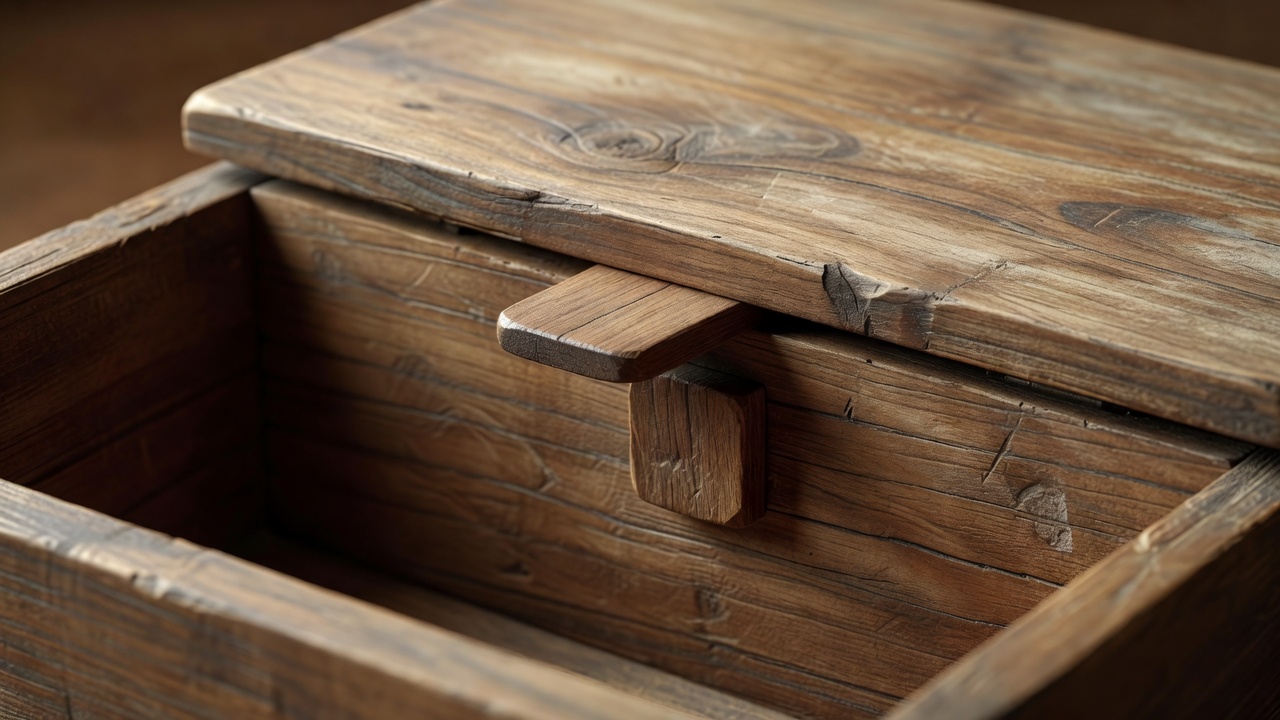
Understand what stops the lid
This mechanism uses a fixed tongue on the underside of a loose lid and a keeper fixed to the inside of the box. In the closed position, the tongue extends beneath the keeper. Lifting brings the tongue against the keeper’s underside. Sliding the lid away from that wall withdraws the tongue; once the overlap is gone, the lid can lift. There is no spring, magnet or concealed force to troubleshoot.
The geometry matters. A conventional lid fitted tightly inside four walls cannot slide sideways, so it is the wrong starting point. Use a lid resting above the rim, with guides that allow a short movement parallel to its surface. Begin with a shallow card tray and an oversized card lid. Removable tape is useful while you work out which wall carries the keeper.
Give the movement somewhere to go
Gather sturdy card, a ruler, pencil, removable tape and scraps for spacers. For a later wooden version, use pre-cut thin plywood, small straight strips and a suitable adhesive. Follow cutting-tool and adhesive instructions, clamp work securely, and avoid handling tiny pieces beside moving blades. Card is a legitimate finished material if you do not have suitable woodworking equipment.
Try an overlap of about 5 mm in the card model and allow about 8 mm of guided travel. These are starting examples: the release travel must exceed the actual overlap plus any misalignment. The tongue also needs vertical room under the keeper so that sliding does not scrape it. Use a temporary paper shim to establish that gap, then remove the shim before testing.
| Relationship | What it does | Simple test |
|---|---|---|
| Tongue overlap | Prevents direct lifting | Lift gently in the closed position |
| Release travel | Withdraws the tongue completely | Observe from the open side |
| Guide clearance | Allows sliding without excessive twisting | Push at each end of the lid |
Assemble it in the open
- Make an inspection tray.Leave one side temporarily open or removable so you can see the catch. Mark the intended sliding direction with a pencil arrow. Do not conceal the mechanism yet.
- Position the tongue.Tape a flat strip beneath the lid so its end reaches under the chosen keeper wall. Make the attachment broad enough that the tongue cannot simply rotate away from the obstruction.
- Add the keeper.Place a block or folded card ledge inside the wall above the tongue. Use a removable spacer to preserve sliding clearance. Keep tape folds and glue beads out of the contact path.
- Fit two side guides.Guide the lid along its intended travel while leaving it free to lift at the release position. Do not add an overhanging guide lip that accidentally traps the lid throughout its movement.
- Mark both positions.Draw a closed mark and a released mark. Confirm visually that the tongue clears before lifting. Add a stop that limits closing travel without obstructing release.
- Repeat, then conceal.Open and close gently several times. Test with the tray resting flat and with a small, ordinary change of angle. Replace the inspection side only when the same motion works consistently.
Make the clue fair
A concealed mechanism can be satisfying without becoming an exercise in random shaking. A narrow seam, a directional grain line or a small thumb recess can suggest sliding. Keep the clue consistent with the actual movement. If the only successful method is prying at a fragile corner, the object is teaching the wrong action.
Invite another person to try the prototype while you observe silently. Note where they push and what movement they expect. If they repeatedly twist the lid, improve the guides or the clue before increasing the difficulty. A fair puzzle lets the solver form and test a useful hypothesis.
The catch works in card but jams in wood
Check the finished thicknesses, guide alignment and glue squeeze-out. Card flexes around errors that wood exposes. Remove the inspection side and watch the first point of contact rather than pushing harder.
The lid lifts without sliding
The overlap may be too small, the tongue may bend or the keeper may be loose. Check the attachments and geometry. Do not compensate by making every sliding surface tighter.
Plan a calm way back in
Keep a removable inspection panel until the complete box has passed repeated testing. Do not permanently glue an unproven lid shut. A recovery opening should let you reach the catch without a sharp tool or a forceful pry. Keep the compartment empty during development so nothing inside can obstruct the tongue.
Traditional Japanese himitsu-bako from the Hakone region offer a useful historical comparison: panel movements can encode an opening sequence. This beginner mechanism is a separate, simplified exercise, not a reproduction of a particular maker’s design. The useful lesson is to understand each movement before adding another.
Describe a catch that keeps sticking