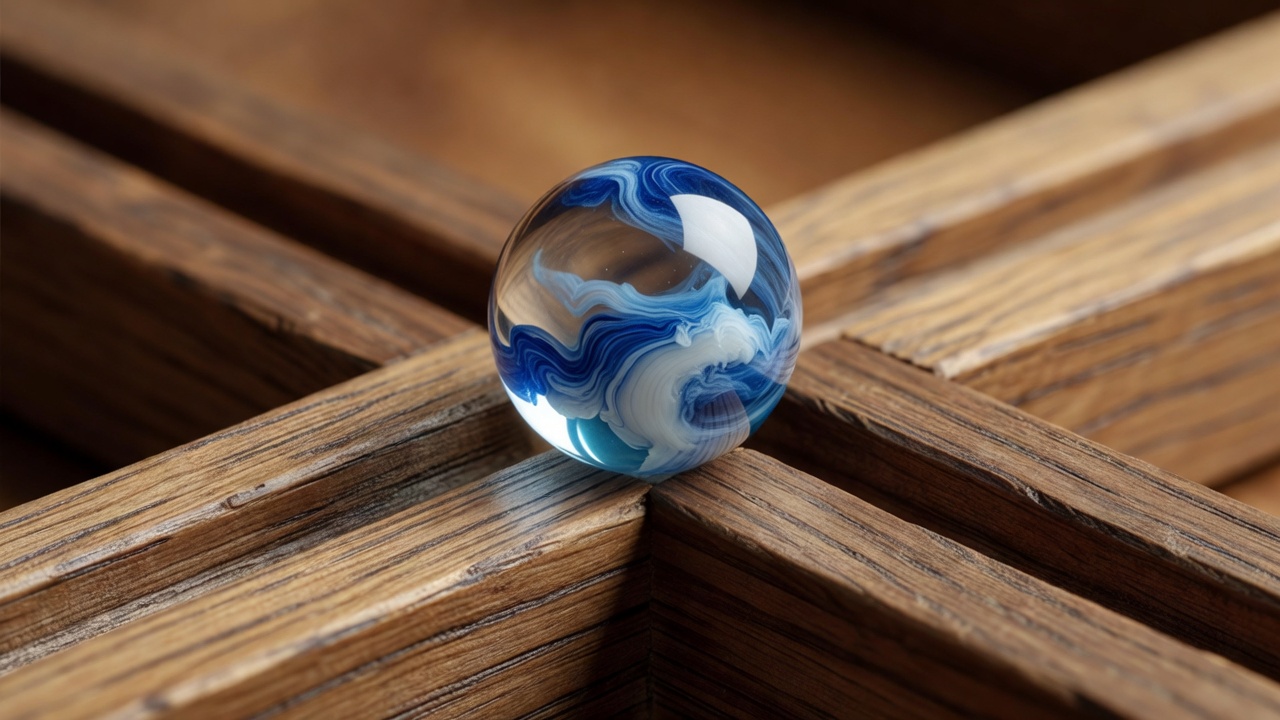
Separate route design from rolling quality
There are two problems to solve. The route must offer understandable choices, and the ball must move reliably wherever the route permits. If you change both at once, it becomes difficult to tell whether a failed attempt is a puzzle decision or a construction fault. Start with a straight run, one turn and one junction. Add complexity only after those three features work.
Use a shallow tray with a smooth, stiff floor. A cereal-box base may need another layer beneath it to resist bending. Folded card strips can become walls; pre-cut wooden strips are a later option. Choose one undamaged marble and use that same marble throughout the test. Small differences between balls can change the behaviour in a narrow passage.
Measure the actual ball
Measure the ball’s diameter with a suitable tool, or compare it carefully between parallel blocks using a ruler. A starting channel width can be the ball diameter plus a few millimetres, but this is a prototype choice, not a universal tolerance. A wider channel allows easier movement; a narrow one demands more accurate walls and corners. Make a short scrap channel before committing to the full tray.
The walls should keep the marble inside during gentle, intended tilting. They are not protection against vigorous shaking. A well-fitted clear cover can help contain the ball, but the cover needs enough headroom and secure attachment. Do not introduce exposed sharp plastic edges. Without a cover, use the maze over a larger tray so an escaped ball is easier to recover.
| Feature | What to observe | Possible adjustment |
|---|---|---|
| Straight run | Ball drifts toward one wall | Check floor flatness and debris |
| Inside turn | Ball wedges at the corner | Widen locally or reshape the wall |
| Junction | Ball catches on a strip end | Align and smooth the exposed end |
| Finish area | Ball rebounds into the route | Add a gentle stopping pocket |
Build the smallest useful maze
- Draw the centre route.Sketch a start, a finish and a few connected decisions. Leave room around the line for the full ball width, wall thickness and turning space. A line that connects on paper can still be too narrow in three dimensions.
- Tape the walls temporarily.Use removable tape outside the rolling surface where possible. Keep the floor clear of curled tape edges. Test a single turn before fitting the remaining walls.
- Roll in both directions.Tilt the tray gently, then reverse the journey. A small step in the floor or an exposed strip end may be harmless one way and obstructive the other.
- Fix one snag.Mark the stopping point in pencil. Remove debris, align the strip or widen the corner. Repeat the same movement before changing a different feature.
- Attach permanently and retest.Use a suitable adhesive according to its instructions. Keep squeeze-out away from the channel, allow the required cure time and repeat the earlier tests after assembly.
Choose difficulty that feels fair
A dead end is a route decision. A glue ridge is a defect. Keep that distinction clear when you invite someone else to test the maze. Begin with visible walls and a modest number of branches. If a player can see why a wrong turn was wrong, the next attempt becomes an informed experiment rather than a guess about faulty construction.
Draw a graph of the route in your notebook: junctions are points and channels are connections. Mark start and finish, then trace a complete path. This simple abstraction helps find an accidentally isolated section before the glue sets. Leonhard Euler’s Königsberg bridge problem is a classic example of reasoning about connections, although a tilting maze adds physical constraints that a graph alone does not capture.
The marble needs a sharp shake to move
Check for a floor dip, glue residue, a narrow channel or a damaged ball. Test the same ball on a clean flat scrap. Do not treat shaking as the normal solution to a construction fault.
The ball jumps the wall at a turn
Reduce the approach speed and examine wall height and cover clearance. Make the corner more gradual if necessary. Keep testing movements gentle rather than designing around forceful handling.
Keep the test conditions recognisable
Record which ball you used, which direction you tilted and which location failed. A small sketch with numbered junctions is enough. Change one variable, repeat the movement several times, and then invite another pair of hands. Different handling often reveals a weak corner that your own familiar technique has learned to avoid.
When the route works, photograph the exposed channels before fitting a cover. That image becomes a useful maintenance map. If a wall later shifts, you can compare its position rather than relying on memory. The finished maze should ask for patient control, not a special trick for getting past an unnoticed snag.
Try a movement puzzle without gravity